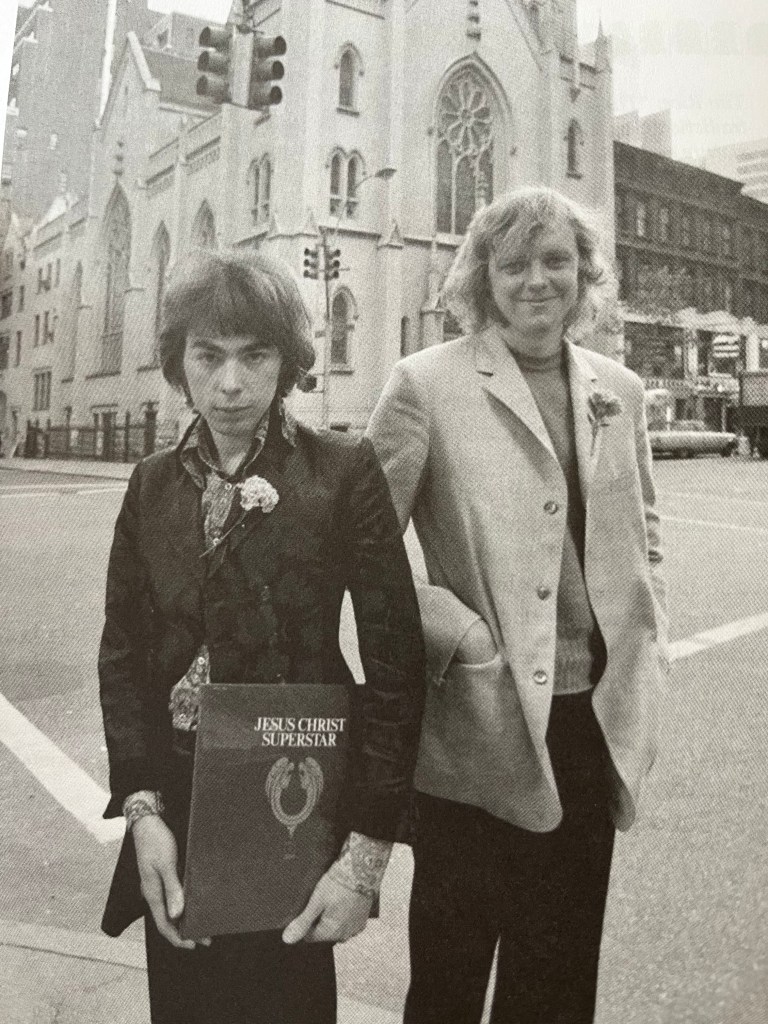
After enjoying success with “Joseph and the Amazing Technicolor Dream Coat”, written in 1965, Andrew Lloyd Webber and Tim Rice began to consider the notion of setting the story of Jesus’s last days (i.e. a Passion Play) in the form of a rock opera. There were many who considered the idea ludicrous and thought the title shocking and irreverent. Tim Rice (who wrote the lyrics) shot back: “I don’t think so. The people who get shocked are those who aren’t that religious. The reaction from clergy and churchmen has been excellent…Anybody who actually wants to think about Christ realizes that if He’s to have any relevance at all, He must have relevance for all times, for all people, in all ways. Therefore Jesus Christ Superstar is Christ in blue jeans.” (Nassour, 135)
Neither Rice nor Webber grew up particularly religious, but the music and play portray their engagement with Anglicanism, and, in the case of Rice’s upbringing, Catholicism. Tim Rice was indoctrinated through his Catholic schooling and became interested in the life of Jesus from the standpoint of history, rather than faith. He remembers wondering as a young person what he would have done had he been in the place of Judas Iscariot or Pontius Pilate. (Brewer, 110)
Rice cited “his most important source [for inspiration] as the Catholic Bishop Fulton Sheen’s Life of Christ: ‘I only wanted to work from one established perspective, and the Bible and Bishop Sheen are about as established as you can get!’” (Brewer, 111).
They then proceeded to focus on the idea of Jesus’s last days in Jerusalem as seen through the eyes of Judas Iscariot. Rice and Lloyd Webber hypothesized that Judas was extremely worried that the focus of Jesus, his miracles, his words and his spirituality, was shifting to the man himself. Judas feared that people were beginning to see him as Messiah while his popularity was snowballing into an out-of-control situation. Judas knew the Roman occupiers were not looking benevolently on these developments. This fear was shared by the Jewish religious authorities.
Andrew Lloyd Webber was interviewed in Ellis Nassour’s book regarding the impetus behind the creation of this work. His quote from the book offers a partial explanation:
“Rice’s fascination with the apostle [Judas Iscariot] began with a lyric in Bob Dylan’s “God on Our Side,” about the morality of wars on his 1964 album The Times They Are a-Changing. The last verse goes: ‘But I can’t think for you. You’ll have to decide / whether Judas Iscariot had God on his side.’” (Nassour, 68)
 Jesus Christ Superstar